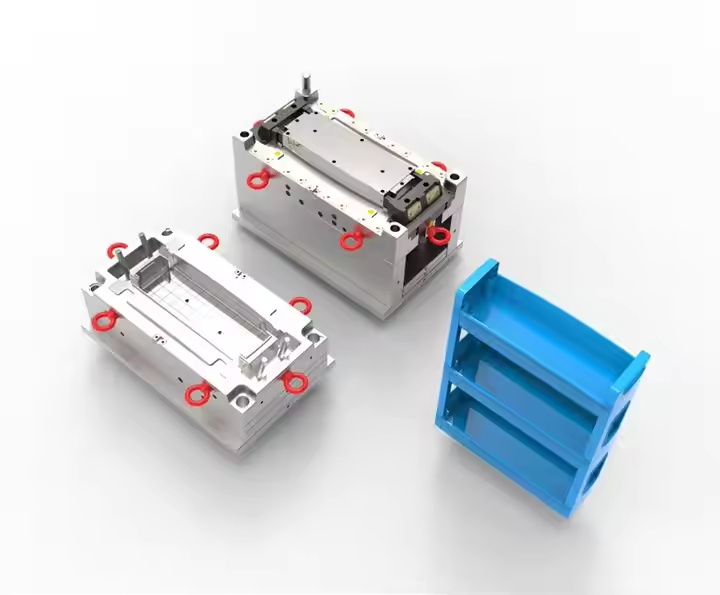
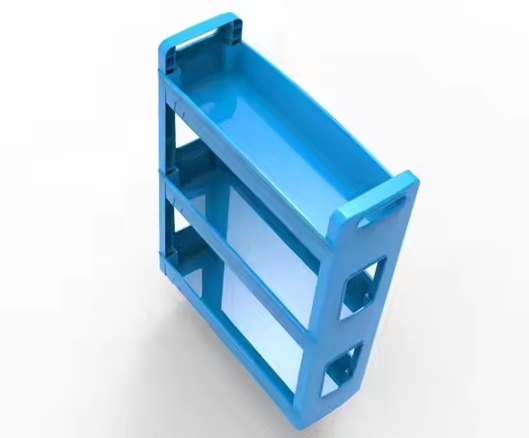
In an era where logistics efficiency dictates commercial competitiveness, plastic storage shelves—the backbone of modern warehousing systems—are undergoing a revolutionary transformation driven by advancements in mold design and manufacturing. This article delves into the technical breakthroughs and industrial value of plastic storage shelf molds through the lenses of material engineering, structural mechanics, and smart manufacturing.
I. Material Revolution: From Single Resins to Composite Enhancements
Traditional plastic storage shelves primarily use PP (polypropylene) or HDPE (high-density polyethylene). However, rising load-bearing demands (from 20kg/layer to 50kg/layer) are pushing mold design to catalyze material innovation.
1. Glass Fiber Reinforcement Breakthroughs
Adding 15%-25% glass fiber (GF) to raw materials triples bending strength.Storage shelf molds designs now incorporate multi-point temperature control systems to ensure uniform GF distribution during injection. A leading manufacturer reduced GF orientation deviation to ±5° through runner optimization, extending product fatigue life by 40%.
2. Microcellular Foaming for Weight Reduction
MuCell microcellular foaming technology enables precise pressure control (±0.2MPa) within storage shelf molds, creating closed-cell structures (50-200μm diameter). A Guangdong-based mold factory achieved 18% weight reduction and 12% material cost savings while retaining over 90% of original mechanical properties.
3. Eco-Material Adaptations
To address PLA (polylactic acid)’s slow crystallization, spiral-tapered cooling channels were designed, boosting cooling efficiency by 27%. Coupled with ±1°C mold temperature control, this innovation enabled stable mass production of PLA shelves.
II. Structural Engineering: Finite Element Analysis-Driven Smart Molds
Modern mold design has shifted from experience-based to data-driven approaches, with CAE (Computer-Aided Engineering) redefining industry standards.
1. Topology-Optimized Lightweighting
Using Altair OptiStruct for load simulations (e.g., 300kg/m² on four-tier shelves), Jiangsu-based manufacturers reduced storage shelf molds frame weight by 22% and lowered stress concentration factors from 2.1 to 1.3, achieving storage shelf molds lifespans exceeding 800,000 cycles.
2. Moldflow Precision Control
Moldflow software optimizes gate layouts for deep cavities (>400mm). Adjusting fan gate angles from 60° to 75° increased weld line strength by 19%, raising product yield from 88% to 97% in automotive projects.
3. Smart Temperature Regulation
Embedding 32-channel sensor arrays with PID algorithms enables zonal temperature control. A Japanese case study showed 15% shorter cycle times and warpage under 0.3mm/m.
III. Smart Manufacturing: Industry 4.0 Reshaping Mold Production
Digitalization is transforming moldstorage shelf molds manufacturing into a closed-loop ecosystem.
1. Five-Axis Machining Precision
DMG MORI five-axis machines directly mill complex cooling channels, achieving surface roughness (Ra) of 0.4μm (vs. 1.6μm via EDM) and ±0.005mm fit accuracy, minimizing flash.
2. 3D-Printed Conformal Cooling
SLM (Selective Laser Melting)-printed bio-inspired cooling channels boost efficiency by 40%, cut cycles to 23 seconds, and eliminate 90% of thermal deformation (German trials).
3. Digital Twin Predictive Maintenance
AI-powered digital twins predict component wear via vibration sensors. A Chinese appliance maker reduced unplanned downtime by 65% with 92% fault prediction accuracy.
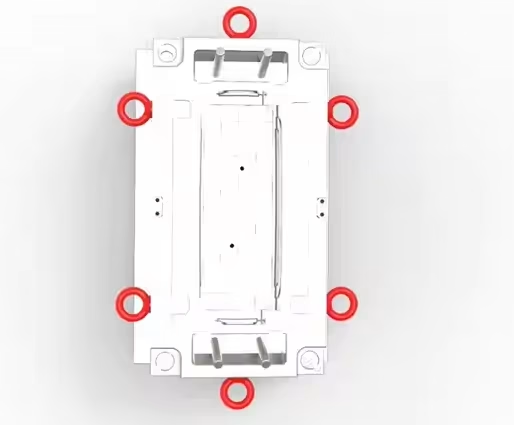
Key Material Selection Criteria
| Component | Material | Hardness (HRC) | Processing |
| Cavity/Core | S136H | 48-52 | Vacuum quenching + cryogenic treatment |
| Sliders | 8407 | 46-48 | Nitriding |
| Ejector Pins | SKD61 | 52-54 | TD coating |
IV. Market Evolution: From Tools to Total Solutions
storage shelf molds manufacturers are transitioning from equipment suppliers to system integrators.
1. Modular Design Systems
Standardized modules (12 frames + 50 inserts) enable mold reconfiguration in 72 hours, slashing R&D cycles from 90 to 21 days for e-commerce clients.
2. IoT-Enabled Sharing Models
Real-time monitoring of 2,000+ molds via IoT platforms supports pay-per-cycle billing ($0.08/cycle), cutting upfront costs by 70% and boosting utilization to 85%.
3. Carbon Footprint Tracking
RFID-embedded molds generate carbon reports, helping a global FMCG brand achieve 31% CO2 reduction per product for ESG compliance.
Conclusion: Precision Molds Powering Logistics Innovation
A million-dollar mold is no longer just a shaping tool—it’s a catalyst for supply chain efficiency. From molecular-level material engineering to AI-driven predictive maintenance, the evolution of plastic shelf molds epitomizes how micro-scale precision fuels macro-scale industrial progress. The channels and cooling systems etched into steel blocks are quietly rewriting the rules of global logistics.