
Industry Background and Importance of gas mask Molds Design
As a core product of personal protective equipment, gas masks are widely used in industries such as industrial, medical, military, and emergency rescue. With the acceleration of industrialization in our country and the strengthening of environmental protection policies, the demand for gas masks in the market continues to grow, with an annual growth rate of over 10%. This trend has placed higher demands on the manufacturing technology of gas masks, and as a key tool for mass production, the design and manufacturing level of molds directly determines the precision, sealing performance, and production efficiency of the products.
The structure of gas mask bodies is complex, requiring high airtightness, comfort, and lightweight features. For example, the sealing frame of the mask body often has a folded edge structure, which poses challenges for the mold’s curved surface modeling and parting surface design. In addition, the integration of functional components such as the filter canister interface and the fixed strap buckle further increases the complexity of the gas mask molds design.
Classification of Gas Mask Molds
Depending on different manufacturing processes and usage requirements, gas mask molds can be divided into several types, including injection molds and blow molds
Injection Molds
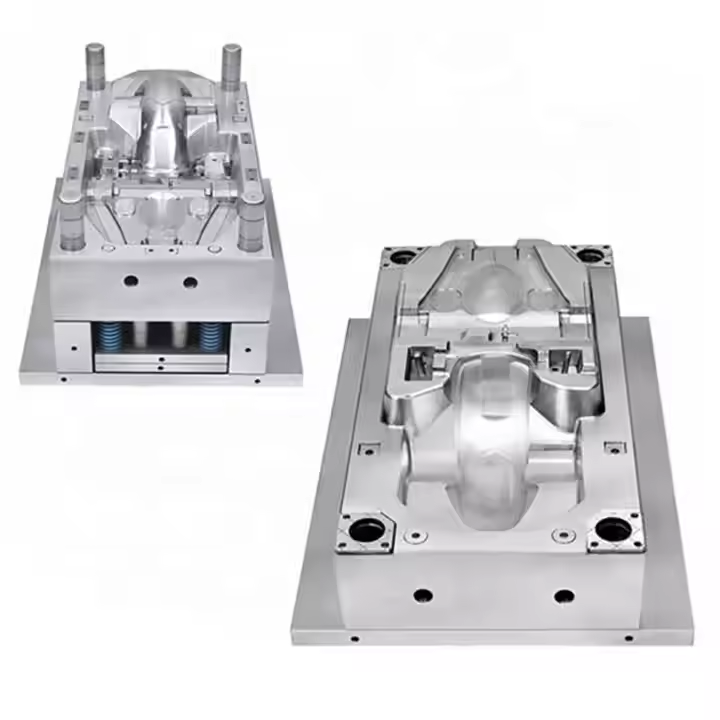
Injection molds are the most commonly used type for manufacturing the outer shell of gas masks. They work by injecting molten plastic into the mold cavity, which then solidifies upon cooling to form the main structure of the mask. The advantages of injection molds include high production efficiency, stable product quality, and high dimensional accuracy.
The manufacturing process requires high-precision machining equipment and a strict quality control system. In the design of injection molds, factors such as the mask’s shape, structure, ventilation hole locations, and connection with the filter canister must be fully considered. For example, to ensure the sealability of the mask, the parting line of the mold must be designed very precisely to avoid flash or burrs that could affect the seal.
Blow Molds
Blow molds are mainly used for manufacturing the transparent visor part of the gas mask. The principle involves heating plastic material until it softens, then inflating it to expand and conform to the mold’s shape, forming a thin-walled product. The advantages of blow molds include the ability to produce lightweight, transparent visors with certain strength. The design of blow molds needs to consider the plastic’s flowability and uniformity during the inflation process. For example, when designing a blow mold, the wall thickness distribution must be reasonably set to ensure uniform strength across different parts of the visor while maintaining transparency and a wide field of vision.
Manufacturing Processes for Gas Mask Molds
The manufacturing process of gas mask molds directly affects the quality and service life of the molds. Common manufacturing processes include CNC machining, electrical discharge machining (EDM), and precision casting.
CNC Machining:CNC machining is one of the main processes for manufacturing high-precision molds today. Through computer-controlled CNC machines, the various components of the mold can be machined with high precision. The advantages of CNC machining include high machining accuracy, efficiency, and the ability to achieve complex shape machining. In the manufacturing of gas mask molds, CNC machining can precisely machine the mold’s cavity, core, parting line, and other key parts. For example, for the cavity part of an injection mold, CNC machining can ensure the surface roughness and dimensional accuracy of the cavity, thereby ensuring the appearance quality and sealability of the mask.
Electrical Discharge Machining (EDM):EDM is a process that uses electrical energy to machine metal materials. It works by using the high temperature generated from electrical discharge to erode metal materials, achieving complex shape machining. The advantage of EDM is that it can machine small and complex structures with high precision. In the manufacturing of gas mask molds, it is often used to machine small ventilation holes, sealing grooves, and other parts. For example, in blow molds, EDM can precisely machine the shape and size of ventilation holes to ensure smooth airflow.
Precision Casting:Precision casting is a method of manufacturing high-precision molds through casting processes. It involves heating metal materials until they melt, then pouring them into a pre-made mold, which solidifies upon cooling to form the desired mold components. The advantage of precision casting is that it can produce mold components with complex shapes and high dimensional accuracy. In the manufacturing of gas mask molds, it is often used to manufacture large mold components, such as the cavity part of injection molds. For example, through precision casting, a cavity with a complex facial contour can be produced to ensure that the mask fits tightly against the human face.

Quality Inspection of Gas Mask Molds
In the production process, quality control of gas mask molds is crucial. Any minor defects may lead to quality issues in the produced gas masks, affecting their protective performance. Therefore, strict quality inspections must be conducted at every stage of mold manufacturing. From raw material inspection to dimensional measurement during the processing, and comprehensive inspection of the finished molds, there is a complete quality control system in place.
High-precision measuring instruments, such as coordinate measuring machines (CMM), are used to accurately measure the critical dimensions of the molds to ensure they meet design requirements. Additionally, the surface quality, hardness, and wear resistance of the molds are also strictly tested, and only molds that pass all inspections can enter the production phase.
During production, injection pressure, temperature, and time parameters must be strictly controlled. Excessive injection pressure may cause material overflow at mold gaps, resulting in flash. Therefore, injection parameters should be precisely adjusted according to the characteristics of the mold and materials, maintaining a stable production state and avoiding flash caused by parameter fluctuations.
Although gas mask molds may appear to be just a production tool, they carry the important mission of safeguarding lives. From design and manufacturing to quality control, every step embodies the essence of technology and craftsmanship. In the future, with continuous technological innovation, gas mask molds will continue to play a crucial role, providing more reliable protection for people in hazardous environments.
>>You may also like
Standards & References
The following industry standards are referenced in this article: