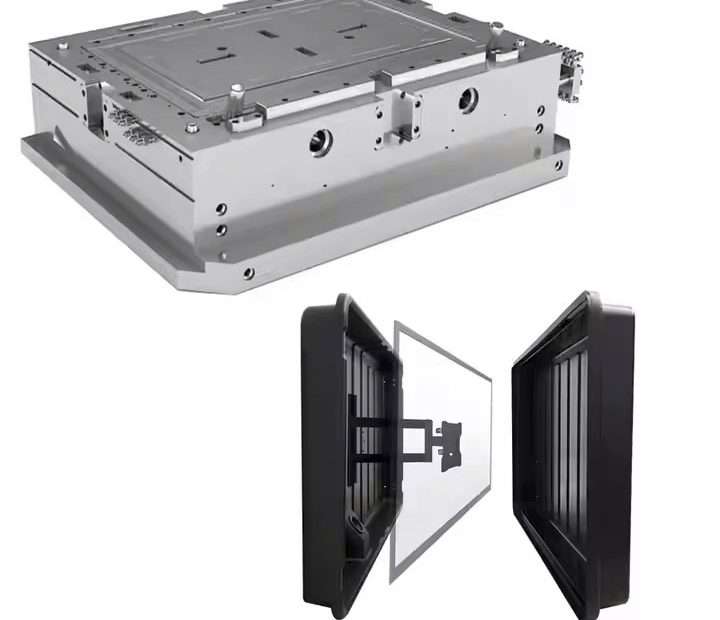
With the widespread adoption of modern home entertainment devices, television has become an indispensable part of people’s lives. As a crucial component of television, the quality and appearance of the TV cover directly affect the overall performance and aesthetics of the television. The design and manufacturing technology of plastic TV cover molds are therefore extremely important.
Overview of Plastic TV Cover Molds
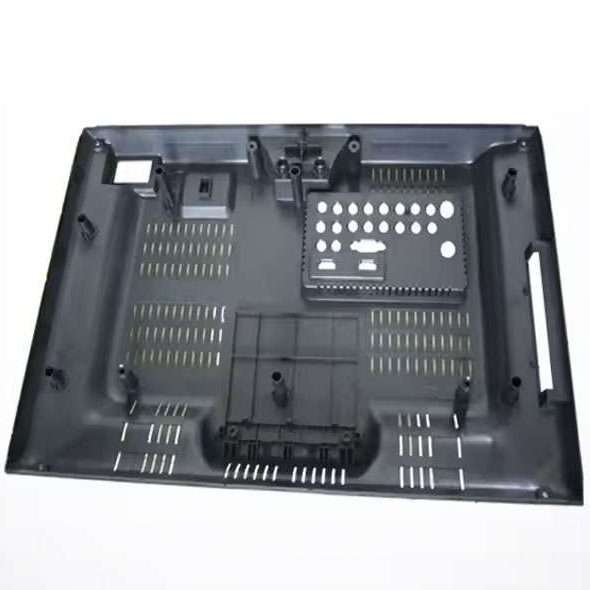
Plastic TV cover molds are specialized molds used for manufacturing the cover plates of TV housings. These molds typically use injection molding processes, where molten plastic is injected into the mold cavity and solidified to form the TV cover. The design and manufacturing of plastic TV cover molds directly impact the molding quality, production efficiency, and appearance of the TV cover.
Design Points of Plastic TV Cover Molds
- Material Selection The plastic TV cover molds has extremely high requirements for materials and needs to select materials with excellent wear resistance, high strength, and good thermal stability, such as high-quality mold steel or hard alloy. These materials can ensure that the mold is not easily worn during long-term production and can maintain a high-precision forming effect.
- Structural Design The structural design of the mold directly affects the forming quality and efficiency of the TV cover. A reasonable structural design should ensure that the plastic is evenly filled in the plastic TV cover molds, avoiding defects such as air bubbles and shrinkage marks. At the same time, the mold should have good opening and closing performance to facilitate rapid demoulding and improve production efficiency.
- Precision Control The size and shape requirements for the TV cover are extremely strict, so precision control of the plastic TV cover molds is crucial. Through high-precision machining equipment and advanced processing techniques, it can be ensured that the dimension accuracy and surface smoothness of the mold meet the required standards, thereby guaranteeing the forming quality of the TV cover.
- Cooling System In the process of plastic forming, the cooling rate has an important impact on the quality of the product. A reasonable cooling system design can accelerate the cooling speed of the plastic, reduce the production cycle, and improve production efficiency. At the same time, uniform cooling can also avoid internal stresses within the product, improving the stability of the product.
- Surface Treatment The surface of the plastic TV cover molds should undergo appropriate treatment, such as polishing and coating, to improve the wear resistance and anti-adhesive properties of the plastic TV cover molds. This not only helps to extend the service life of the plastic TV cover molds but also ensures the smoothness and texture of the surface of the TV cover.
Manufacturing Process of Plastic TV Cover Molds
- Material Cutting and Pretreatment According to the design requirements, the selected materials are cut into the appropriate size and shape, and necessary pretreatments such as annealing and quenching are performed to eliminate internal stresses of the material and improve its machinability.
- Forming Processing Using advanced technologies such as CNC machining centers and Electrical Discharge Machining (EDM) to precisely machine the materials to form the basic shape of the mold. These technologies can ensure the high precision and realization of complex structures of the mold.
- Polishing and Polishing Through manual fine grinding or mechanical polishing, the surface of the mold reaches a very high degree of smoothness and flatness. This not only helps to improve the wear resistance of the mold but also ensures the smoothness and texture of the surface of the TV cover.
- Assembly and Debugging The processed mold parts are assembled and necessary debugging is performed to ensure the precision and stability of the mold. This step is crucial for ensuring the forming quality of the TV cover.
- Surface Treatment and Coating According to the needs, the surface of the mold is treated with electroplating, chemical coating, etc., to improve the wear resistance and corrosion resistance of the mold. These treatments can not only extend the service life of the mold but also improve the appearance quality of the TV cover.
- Quality Inspection and Packaging Strictly inspect the finished mold, including dimension accuracy, surface smoothness, hardness, and other aspects. After passing the inspection, package and label it for shipment. This step is an important link to ensure mold quality and customer satisfaction.
Classification of Plastic TV Cover Molds
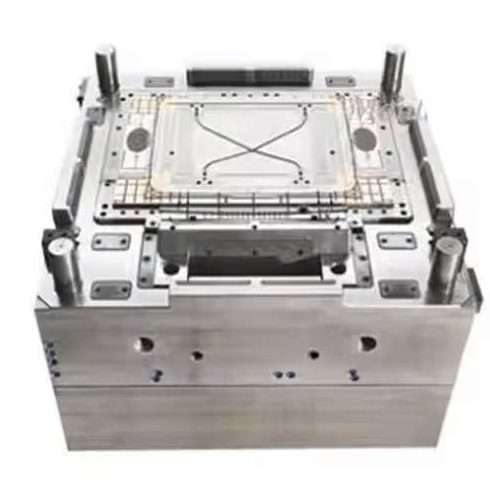
- Injection Mold: It is the most widely used forming mold in the production of thermoplastic plastic products, and the corresponding processing equipment is a plastic injection molding machine. The plastic is melted in the heated barrel at the bottom of the injection machine, and then enters the mold cavity through the nozzle of the injection machine and the gating system of the mold, and is cooled, hardened, and demolded to obtain the product after cooling. Its structure usually consists of forming parts, gating systems, guiding parts, ejector mechanisms, temperature regulating systems, exhaust systems, supporting parts, etc. The manufacturing materials are usually plastic mold steel modules, such as plain carbon structural steel, plain carbon tool steel, alloy tool steel, high-speed steel, etc.
- Compression Mold: It includes compression molding and injection compression molding, which are mainly used for forming thermosetting plastics. Compression molding heats the mold to the forming temperature, puts in the measured compressed powder, and after the mold is closed, the plastic softens, flows under high heat and high pressure, and solidifies to form. Injection compression molding has a separate charging chamber. Before forming, the mold is closed first, and the plastic is preheated to a viscous state in the charging chamber. Then it flows into the mold cavity under pressure to form after solidification. Compression molds mainly consist of cavity, charging cavity, guiding mechanism, ejector parts, heating system, etc. The materials used for manufacturing are basically the same as those for injection molds.
- Extrusion Mold: It is a type of mold used to form and produce continuous-shaped plastic products, also known as an extrusion die head, and is widely used in the processing of pipes, rods, monofilaments, plates, films, wire and cable sheaths, profiled materials, etc. Solid plastic melts and plasticizes under the condition of heating and screw rotation and extrusion of the extruder, and forms a continuous plastic product with a cross-sectional shape identical to that of the die through a die with a specific shape. Its manufacturing materials are mainly plain carbon structural steel, alloy tool steel, etc. Some wear-resistant parts will be inlaid with wear-resistant materials such as diamond.
- Blow Mold: It is a mold used to form hollow plastic containers such as beverage bottles and various packaging containers for daily chemical products. Blow molding can be divided into extrusion blow molding, injection blow molding, injection stretch blow molding (commonly known as “blown film”), multi-layer blow molding, sheet blow molding, etc. The structure of blow molds is relatively simple, and the materials used are mostly made of plain carbon steel.
Can the mold be customized?
Our factory specializes in custom mold making, offering a wide range of options to meet your specific needs. Whether you require injection molds for precise and efficient production of plastic parts, compression molds for forming resilient and durable components, or blow molds for creating seamless and sturdy hollow products, we have the expertise and state-of-the-art technology to deliver exceptional results. Our team works closely with you to understand your unique requirements, ensuring that every detail is tailored to your exact specifications. With a commitment to precision, quality, and timely delivery, our factory is your trusted partner for all your custom mold needs, helping you bring your innovative product designs to life with the highest level of craftsmanship and efficiency.
>>You may also like
Standards & References
The following industry standards are referenced in this article: