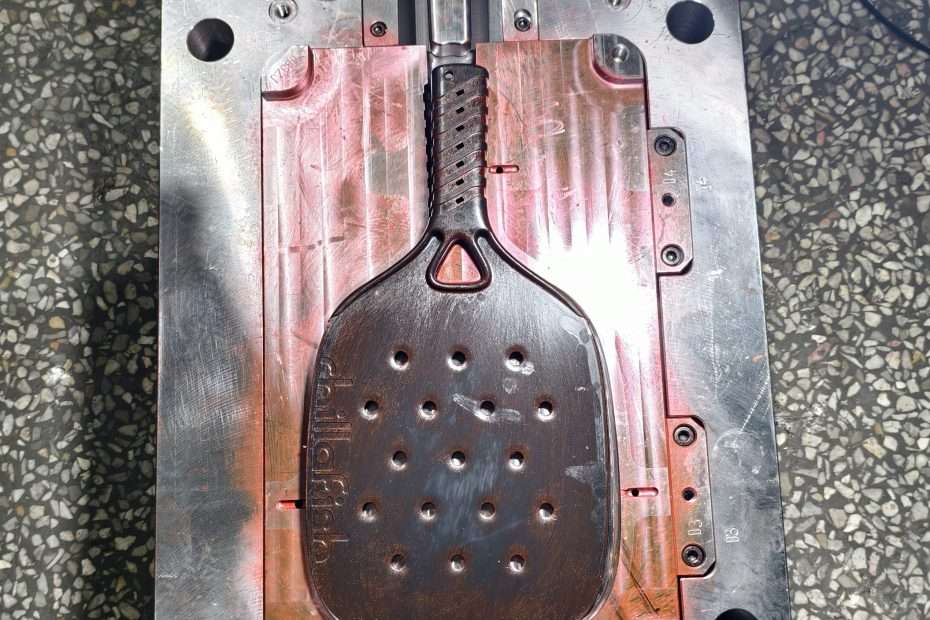
Rackets are indispensable equipment in both competitive sports and leisure activities. Whether it’s badminton, table tennis, or tennis, a good racket can significantly enhance an athlete’s performance. Behind the scenes, the manufacturing process of rackets is crucial, and among the various factors ensuring racket quality, the design and use of racket molds play a pivotal role.
Historical Background
The development of rackets dates back several centuries, but modern racket manufacturing began in the 20th century. With advancements in material science and engineering technology, traditional wooden rackets have gradually been replaced by composite material rackets. The design of racket molds has also evolved from simple hand carving to complex CNC machining.
Importance of Racket Molds
Racket molds form the foundation for producing high-quality rackets. They determine critical performance indicators such as the shape, weight distribution, and flatness of the hitting surface. A precisely designed mold ensures consistent performance across all rackets produced, which is particularly important for mass production. Additionally, with advancements in technology and materials, racket molds are constantly evolving to accommodate new materials and processes.
Design Considerations
Durability and Maintenance: The lifespan and maintenance cost of the mold are also factors to consider during design. Easy-to-clean and maintain molds can reduce downtime during production, lowering manufacturing costs.
Shape and Size: Molds need to be designed based on the characteristics of different racket sports. For example, badminton rackets are usually longer and lighter for quick swings, while tennis rackets are heavier to provide sufficient power and stability.
Weight Distribution: By adjusting the internal structure of the mold, the weight distribution of the racket can be controlled, affecting the balance point and swing weight. This is crucial for improving the control and power output of the racket.
Material Compatibility: Modern rackets are often made from composite materials like carbon fiber and fiberglass, which have specific requirements for mold temperature and pressure. Therefore, mold design must consider factors such as the coefficient of thermal expansion and curing temperature of the materials.
Surface Treatment: The quality of the mold surface directly impacts the flatness and aesthetics of the racket surface. High-quality mold surfaces can reduce the need for subsequent processing, increasing production efficiency.
Manufacturing Process
The manufacturing process of racket molds typically includes the following steps:
- Design and Simulation: Using computer-aided design (CAD) software to create a 3D model of the mold and performing finite element analysis (FEA) to optimize design parameters.
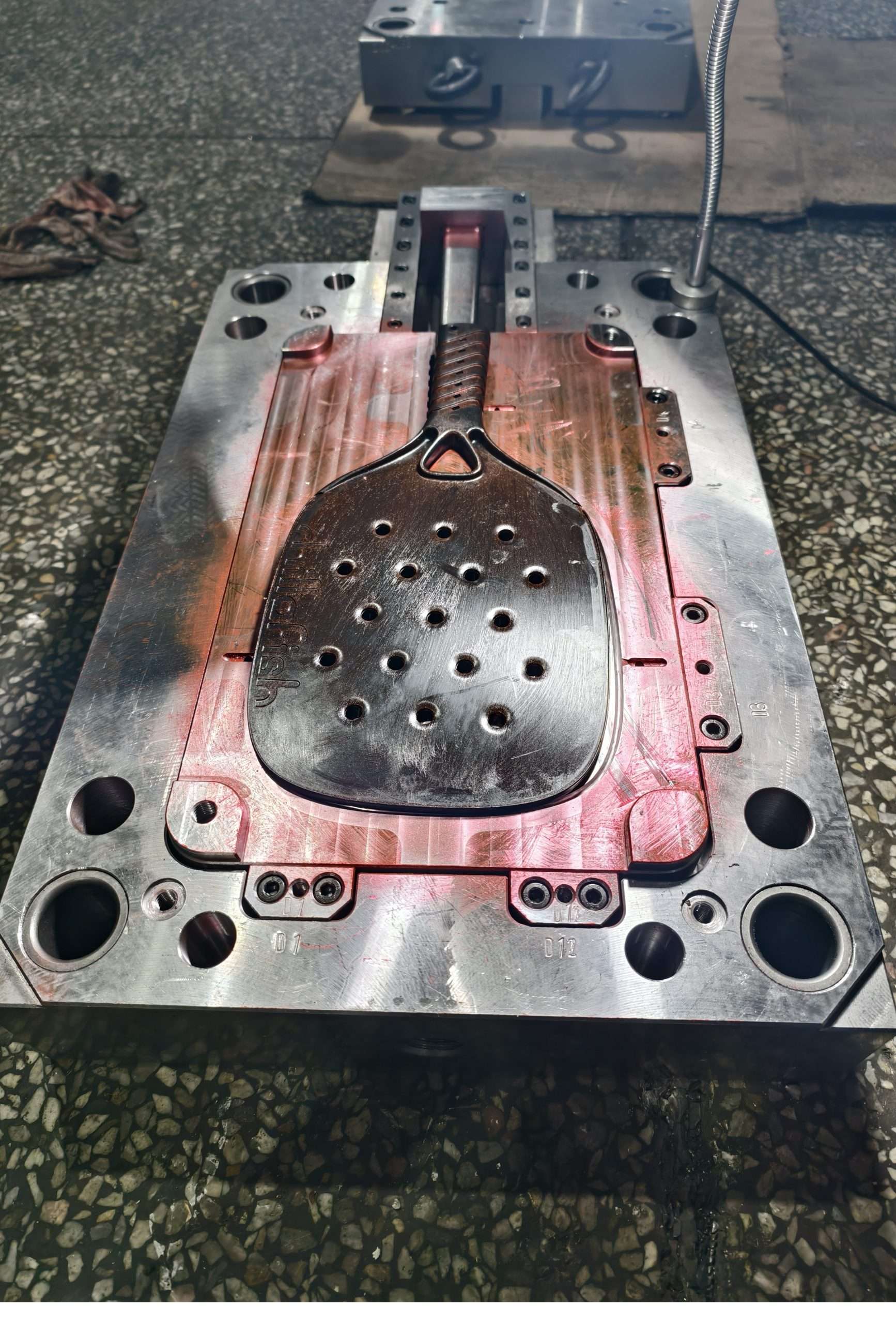
- Prototype Production: Based on the design drawings, using CNC machining equipment to create a mold prototype. This process requires high-precision machining equipment and skilled technicians.
- Forming Process: Placing composite materials in the mold and using heating and pressing techniques to shape the material in the mold. This process requires precise control of temperature and pressure to ensure uniform material distribution and ideal mechanical properties.
- Quality Inspection: Using non-destructive testing and mechanical performance testing to ensure the mold and finished racket meet design requirements and quality standards.

What is the role of finite element analysis (FEA) in mold design?
Finite Element Analysis (FEA) plays a crucial role in racket molds design. It is a numerical computation method used to simulate and analyze the behavior of complex structures under various conditions. Here are the main functions of FEA in mold design:
- Optimizi Design: FEA helps engineers identify the best mold design by simulating different design scenarios. This can reduce material usage, lower costs, and ensure the strength and durability of the mold.
- Predicting Performance: Engineers can use FEA to predict the mold’s performance in actual use, such as stress distribution, deformation, and temperature fields. This helps identify potential issues early in the design phase and make necessary adjustment.
- Improving Efficiency: By conducting virtual tests with FEA, the number of physical prototypes needed can be reduced, shortening the design cycle and lowering research and development costs.
- Quality Control: The simulation results from FEA can be used to optimize the manufacturing process of the racket molds, ensuring the quality and consistency of the final product.
- Failure Analysis: When issues arise with the mold, FEA can help engineers analyze the causes of failure and find solutions, thereby improving the design and manufacturing process.
Overall, Finite Element Analysis significantly enhances the accuracy and efficiency of mold design, providing robust technical support for the production of high-performance molds.
What is the role of CNC machining in racket molds manufacturing?
High Precision: CNC machining equipment can achieve extremely high machining precision, ensuring the accuracy of all parts of the mold. This is especially important for manufacturing molds with complex shapes and fine details.
Increased Efficiency: CNC machining has a high degree of automation and can operate continuously without human intervention, greatly improving production efficiency. Additionally, CNC machining can quickly switch machining tasks, accommodating the needs of multi-variety, small-batch production.
Complex Shape Processing: CNC machining can handle complex three-dimensional surfaces and structures, which are difficult to achieve with traditional manual machining. Through CNC programming, precise machining of complex molds can be realized.
High Material Utilization: CNC machining can optimize cutting paths to reduce material waste and improve material utilization. This not only reduces production costs but is also more environmentally friendly.
Consistency in Quality: The CNC machining process is stable, avoiding errors and inconsistencies due to human operation, ensuring consistency and high quality of each mold.
Flexibility: CNC machining equipment can quickly adjust and change machining parameters through programming to adapt to different mold designs and manufacturing needs. This makes the production process more flexible and adaptable.
Safety: CNC machining reduces the chances of operators directly contacting cutting tools and workpieces, lowering the risk of work injuries and enhancing production safety.
What are the requirements for the heating and pressurizing process of racket molds?
The heating and pressing process of racket molds is crucial in manufacturing. First, the heating must be uniform to ensure that all materials within the mold reach the required temperature, avoiding localized overheating or underheating, while also precisely controlling the temperature to maintain the material properties. Second, the applied pressure must be evenly distributed to ensure uniform material filling within the mold, avoiding bubbles or defects, and the pressure must be sufficient to ensure full material formation without damaging the mold or material.
Additionally, the heating time and holding time must be properly controlled to ensure the material fully softens and flows to achieve the desired forming effect, and the cooling rate needs to be moderate to avoid increased internal stress leading to product deformation or cracking, while also ensuring uniform cooling of the material within the mold to prevent thermal stress.
The manufacturing process requires efficient and stable heating equipment, such as electric heaters or hot presses, as well as hydraulic or mechanical pressure equipment to apply uniform and controllable pressure. Meanwhile, the processing environment’s temperature and humidity also need to be controlled to prevent impacting the material and mold performance. By strictly controlling these process parameters, the racket molds manufacturing process can proceed smoothly, producing high-quality, high-performance rackets.